03 · Inside the palace
The interior is a route through how Venice governed
The most useful way to remember the rooms is by function: ceremony, diplomacy, executive government, justice, mass assembly and confinement.
01
Courtyard
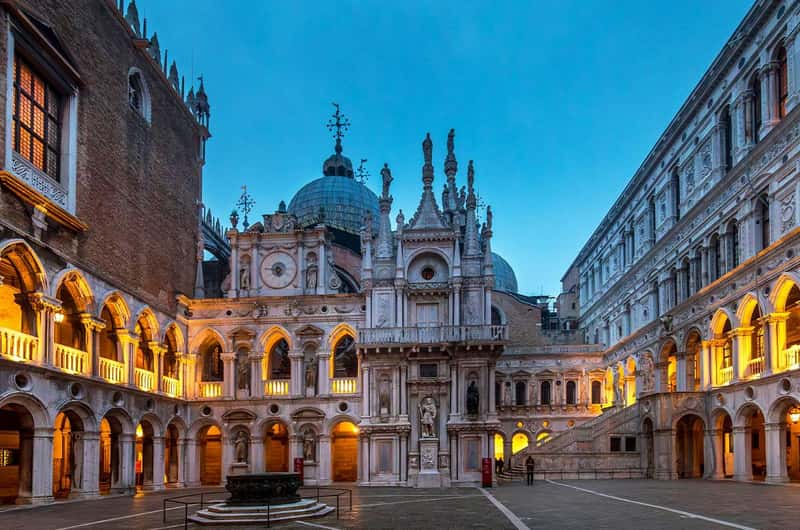
Giants’ Staircase: authority staged in stone
The Scala dei Giganti was the palace’s formal ceremonial staircase. At its top stand Jacopo Sansovino’s colossal Mars and Neptune, installed in 1565 and commonly read as symbols of Venice’s power on land and at sea.
Look for
The scale of the statues against the human-sized staircase: ceremony here was deliberately theatrical.
02
Upper floors
Golden Staircase: access itself became spectacle
The Scala d’Oro led towards the upper state rooms and is named for its rich gilded stucco decoration. It was not merely circulation: the transition into the political heart of the palace was designed to impress high-ranking visitors.
Look for
How architecture becomes more decorative as the route approaches elite government rooms.
03
Diplomacy
Anticollegio: waiting was part of the performance
This was the honourable waiting room for ambassadors before audiences with the Collegio. Its paintings by Tintoretto and Veronese turned diplomatic waiting into an encounter with Venice’s preferred image of itself: cultured, prosperous and wisely governed.
Look for
Veronese’s Rape of Europa and the way mythological painting surrounds a real political function.
04
Executive government
Collegio: where foreign policy met ceremonial display
The Collegio brought together important governing bodies and received ambassadors. After the 1574 fire, its decoration was renewed; Veronese’s ceiling paintings celebrate virtues associated with good government, while the room’s arrangement focused attention on the tribunal.
Why it is worth time
This room makes the relationship between art and actual state business unusually clear.
05
Senate
Senate Chamber: economics, war and foreign affairs
The Senate handled major economic and financial matters and played a central role in foreign policy. The decoration is not neutral background: religious imagery, history and portraits helped frame political decision-making within a larger moral story.
Look for
How paintings occupy the upper walls and ceiling, literally surrounding political debate.
06
State security
Council of Ten: power behind a smaller room
The Council of Ten originated after the 1310 conspiracy associated with Bajamonte Tiepolo and became a permanent body concerned with state security and other sensitive matters. Its chamber is smaller than the Great Council Hall but politically significant.
Look for
The ceiling’s allegories of authority and justice rather than judging importance by room size.
07
Great Council
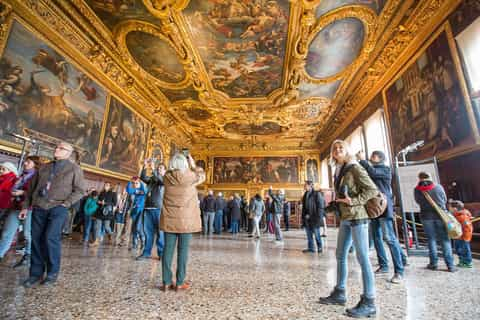
Great Council Chamber: the scale of a republic
At about 53 metres long and 25 metres wide, the Sala del Maggior Consiglio is the palace’s most monumental political space. It accommodated the Great Council, composed of Venice’s male patrician class, and could hold a very large assembly.
Do not rush through
Stand back before studying individual paintings—the size of the room itself explains the scale of Venetian patrician government.
08
Elections
Scrutinio: where voting became architecture
The Sala dello Scrutinio was eventually used for electoral operations. Its function helps explain why the palace needed more than spectacular audience rooms: Venice required specialised spaces for the procedures that kept its institutions working.
Visitor takeaway
Some of the palace’s most interesting rooms are important because of what happened there, not just because of decoration.